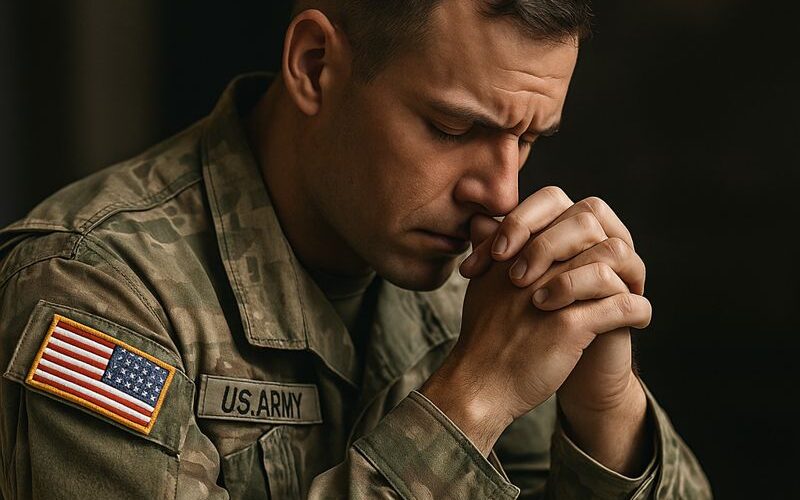
A soldier whispers a prayer before a convoy. A Sikh airman keeps uncut hair and beard as an act of obedience. A Jewish officer wears a yarmulke as a daily reminder of covenant. These practices are not “extras.” For many service members, they are the moral spine that helps them endure fear, grief, and responsibility.
Religious Freedom Under Fire Magazine’s position is simple: religious liberty in the ranks is not a special privilege. It is a readiness and retention issue in an all-volunteer force. When troops are forced to choose between sincerely held belief and career, the military loses capable people, undermines trust in command, and signals that service requires leaving one’s convictions behind.
From tolerance to protected liberty
The modern legal story begins with Goldman v. Weinberger (1986), when the Supreme Court upheld an Air Force rule that prevented an Orthodox Jewish officer from wearing his yarmulke indoors. Congress responded by permitting modest religious apparel, rejecting the idea that rigid uniformity should automatically override individual liberty.
That evolution culminated in Department of Defense Instruction (DoDI) 1300.17, “Religious Liberty in the Military Services” (September 1, 2020). (WHS ESD) The title reflects the point: faith is not merely something to be “accommodated,” it is a liberty to be protected. Practically, the instruction directs leaders to approach religious accommodation requests with a presumption of approval and deny them only for narrowly defined reasons tied to readiness, mission, cohesion, good order, law, or safety.
DoDI 1300.17 also aligns with the Religious Freedom Restoration Act (RFRA), which requires the federal government to meet a demanding test when it substantially burdens religious exercise. (Congress.gov) In short, commanders can enforce standards—but denials should be individualized, evidence-based, and as narrow as possible.
Why the lived reality still feels uncertain
If the rules are this clear, why do so many service members describe a climate of uncertainty? Because in several high-profile episodes, the system has acted as if religious liberty is optional—and troops have noticed.
The vaccine mandate: a stress test the system failed
The 2021 COVID-19 vaccine mandate became a stress test for whether the military would apply its stated “bias in favor of approval.” RFUF’s advocacy paper reports that roughly 28,000 religious accommodation requests were submitted across the services and fewer than 400 were approved.
That near-categorical denial posture had real consequences: separations, stalled careers, and disrupted benefits. It also drove class-action litigation. In U.S. Navy SEALs 1–26 v. Biden, the Navy reached a settlement requiring reviews and corrections of personnel files, expungement of adverse information tied to the mandate, and protections against discrimination on promotion boards for a defined period. (Military.com)
Whatever one thinks of the public-health goal, the institutional lesson is straightforward: “individualized review” cannot mean “deny almost everyone.” When it takes litigation to force policy back toward its stated standard, trust erodes—and retention suffers.
Grooming and beards: a “Goldman” echo in a new decade
A second conflict has emerged around grooming standards and religious appearance, particularly beards. RFUF’s paper describes proposed changes that would reverse years of progress and pressure service members from multiple faiths to choose between religious practice and service. Recent reporting and congressional correspondence in 2025 likewise raised concerns that “pre-2010” approaches to religious accommodations for facial hair could affect Sikh, Muslim, Jewish, and other service members. (Axios)
This is often framed as discipline versus self-expression. But religious grooming standards are neither fashion nor rebellion. The U.S. military has already demonstrated that professional standards and religious accommodations can coexist. If the Department reverts to rules that treat accommodations as rare exceptions rather than protected liberty, it will tell thousands of capable volunteers that they are welcome only if they compromise core religious commitments.
Chaplaincy support: when “access” exists only on paper
Religious liberty is also about whether troops can access spiritual care. RFUF highlights the Army’s 2025 decision to cancel religious support contracts for key chapel roles such as Coordinators of Religious Education, Catholic Pastoral Life Coordinators, and musicians—support functions that help chapels serve soldiers and families. The Archdiocese for the Military Services argued these cancellations over-burden chaplains and impede free exercise, particularly given existing shortages. (Archdiocese for the Military, USA)
The point is not denominational politics. It is operational access. A right that cannot be meaningfully exercised—because the support structure has been removed—is a right in name only.
Why this is a national security issue
Religious liberty helps the force recruit, retain, and sustain the whole person. RFUF notes testimony that highly religious young Americans can be more likely to serve—meaning policies perceived as hostile to faith can shape who is willing to volunteer. Academic research has similarly examined links between religious involvement and military service among young adults. (Military Atheists Association) And DoD-adjacent research shows religion remains a meaningful factor in the force’s composition over time. (RAND Corporation)
Religious liberty also supports resilience and ethical performance. Many service members rely on faith communities and chaplains for meaning-making, moral grounding, and confidential counsel that commanders cannot replicate—especially when confronting grief, moral injury, or despair. (Even within military health and readiness discussions, “spiritual readiness” is regularly treated as part of holistic readiness.) (Wiley Online Library)
A constructive path forward
The question is not whether the military should have standards—it must. The question is whether the Department will treat religious liberty as a strategic priority, consistent with DoDI 1300.17 and RFRA, or as a discretionary benefit vulnerable to shifting preferences. (WHS ESD)
Three practical reforms would move the force in the right direction:
- Re-commit to individualized review and a presumption of approval, with evidence-based, narrowly tailored denials.
- Provide timely remedies where the system failed, including corrections to records and career impacts—so trust can be rebuilt rather than litigated back into existence. (Military.com)
- Train leaders to apply the law and DoD policy consistently, treating religious liberty as operationally important, not as an afterthought.
America’s strength has never been uniformity of belief. It has been unity of purpose among citizens of many faiths, and of none. A well-rounded military that represents the best of the United States must be one where people can serve with integrity, without being coerced to surrender conscience. Protecting religious freedom in uniform is not a concession. It is a constitutional obligation—and an investment in readiness.
Additional Resource
Video Overview

Steve Bowcut is an award-winning journalist. He is an editor and writer for Religious Freedom Under Fire as well as other security and non-security online publications. Follow and connect with Steve on Substack and Facebook.